

For years, the Capital has lost a great deal of urban farmland and green spaces. This is due to rapid, unplanned urban development, but also to the lack of urban planning and investment, and the proliferation of often illegal infill works. And yet, farmland and green spaces are very important for the population.
Urban agriculture is crucial. It provides income to many people, contributes to food supply, plays a role in water sanitation, and is essential for regulating floods. It is also part of the city’s identity.
As for green spaces, they are very important for quality of life. Beyond being decorative elements that beautify the city, they are essential to allow residents and their children to enjoy quality moments.
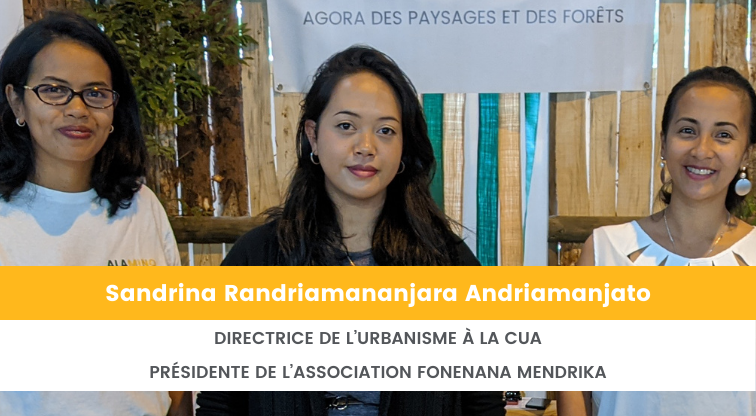
Sandrina Randriamananjara Andriamanjato, Director of Urban Planning at the Urban Municipality of Antananarivo and co-founder of INDRI, tells us more about the challenges in this area and the work of the Urban Municipality of Antananarivo (CUA) to preserve these spaces and create new ones.
As Director of Urban Planning, you are notably in charge of issues related to urban agriculture and green spaces in Tana. Could you summarize the situation on these issues?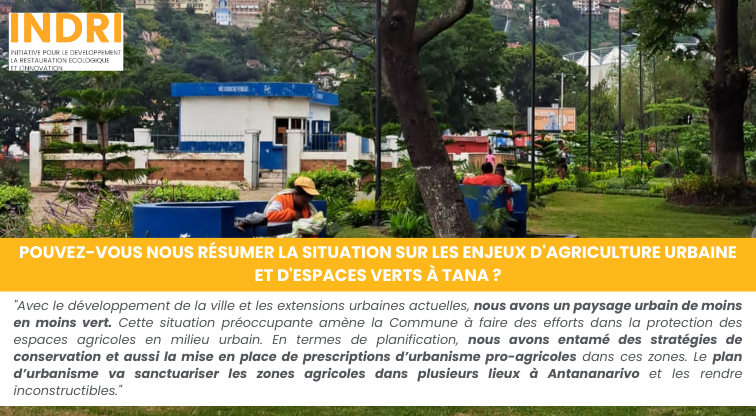
Antananarivo is historically a city surrounded by rice paddies. Urban agriculture is part of the capital’s urban landscape, history, and customs. With the city’s development and current urban expansion, we have less and less of this green landscape. This worrying situation has led the Municipality to make efforts to protect these urban farmland areas. In terms of planning, we have launched conservation strategies and the implementation of pro-agricultural urban planning rules in these areas. In other words, the urban plan will safeguard these agricultural zones in several places in Antananarivo and make them non-buildable. This will simultaneously preserve wetlands that serve as water reservoirs, maintain the income sources of many people, and preserve the urban landscape as we know it — which is part of the Capital’s identity.
Regarding urban farming, what is its importance and how is the situation evolving?
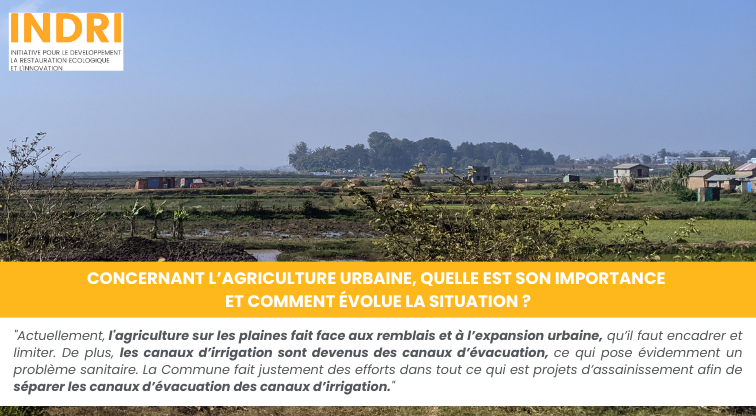
There are two types of agriculture in Antananarivo: agriculture on the hills and agriculture in the plains. Currently, agriculture in the plains is facing infill works and urban expansion, which need to be regulated and limited. In addition, it receives huge volumes of wastewater, which makes the consumability of products problematic. Today, irrigation channels have become drainage channels, hence our sanitation problems in the city. Faced with this, infrastructure must be adapted to regulate water flows. The Municipality is making efforts on all sanitation projects in order to separate drainage channels from irrigation channels.
What are you trying to accomplish in terms of urban farming?
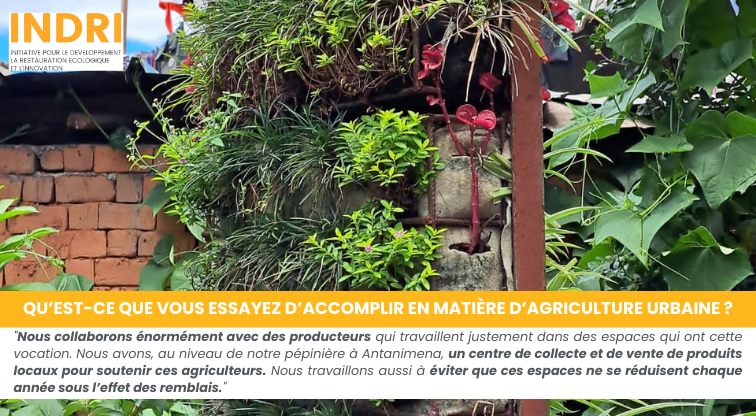
In urban farming, we work extensively with supervised producers who work in spaces dedicated to this purpose. At our nursery in Antanimena, we have a collection and sales centre for local products to support these farmers. We also work to prevent these areas from shrinking each year due to infill works.
Many people are concerned about these numerous infills. Year after year, they reduce farmland and worsen flooding. How is the CUA trying to address this problem?
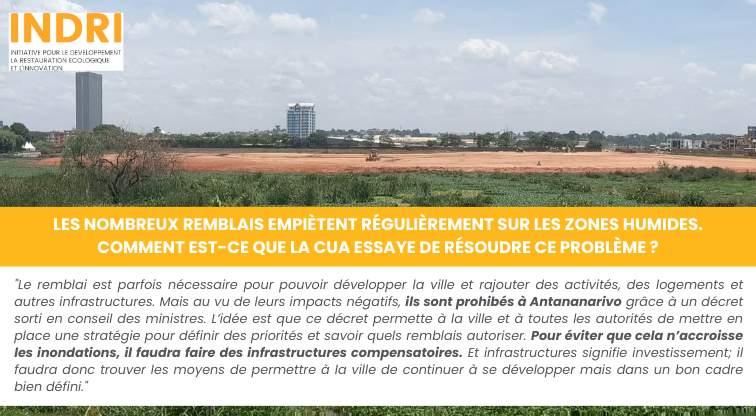
A distinction must be made between infill and sanitation. Infill is a construction technique, like any other, that allows land or surfaces to be transformed and modified to enable installation and better construction. In Antananarivo, infill consists of transforming former rice paddies and wetlands into solid ground for construction. It is a necessity for urban expansion, since we no longer have much buildable land. Infill is sometimes necessary in order to develop the city and add activities, housing, and other infrastructure.
That said, given the negative impacts of these infills, they are currently prohibited in Antananarivo by a decree issued in the Council of Ministers. The idea is that this decree should allow the city and all the authorities to put a strategy in place to define priorities and invest accordingly. To lift this decree, priorities will need to be defined first to enable the development of certain areas. To prevent flooding from worsening, compensatory infrastructure will be needed. And infrastructure means investment, which means money — so we will need to find the means to allow the city to continue developing within a well-defined framework.
What other actions are you taking to reduce the risk of flooding?
Flooding is a major challenge. Antananarivo is facing climate change, which has led to an increase in rainfall in recent years. On the other hand, we are also facing a lack of sanitation infrastructure. The city has not prepared to receive the water it is supposed to handle: there is a shortage of primary, secondary, and tertiary canals and retention basins to contain the volume of water that engulfs the city and floods it during the rainy season.
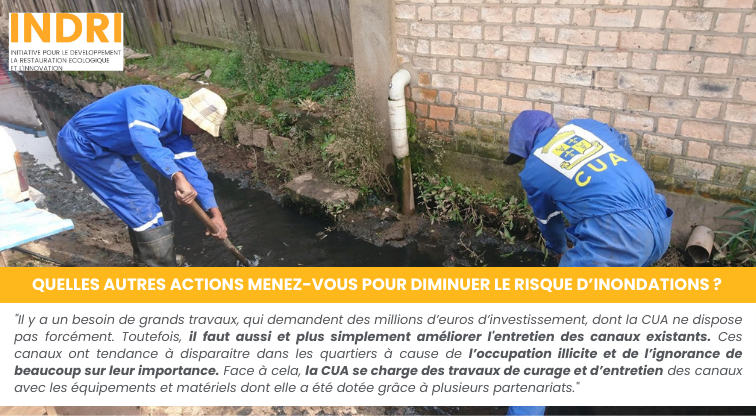
There is a need for major works, requiring millions of euros in investment, which the CUA does not necessarily have at its level. However, simpler maintenance of existing canals must also be improved. Unfortunately, these canals are gradually disappearing in the neighbourhoods due to illegal occupation and to many people’s ignorance of their importance. To address this, the CUA carries out canal cleaning and maintenance works. Fortunately, we have a great deal of equipment and materials thanks to partnerships that allow us to carry out these works each year.
It should be noted that the main enemy of our canals is the waste that blocks the proper flow of water. To address this, we conduct extensive citizen awareness activities at neighbourhood level to invite people to deposit their waste in waste bins and intermediate containers rather than throwing it directly into the canals. There are several fronts on which we must work to solve sanitation problems in Antananarivo.
Regarding green spaces, everyone has noticed that the city has made investments, particularly in Ambohijatovo. Could you explain the municipality’s objectives in this area? How is this important among all the challenges facing the capital?
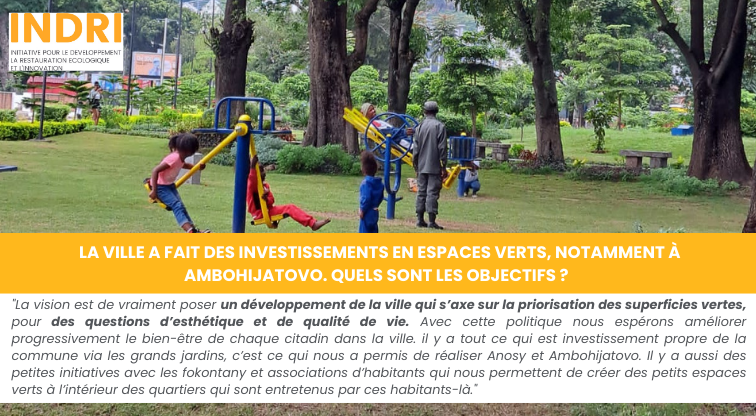
Green spaces are indeed among the Mayor’s priorities. His programme features “Antananarivo, green city.” The vision is to truly establish urban development that prioritizes green areas — first for aesthetic reasons, because a more beautiful city allows people to feel better in their lives and to claim ownership of it.
A city with green spaces is much healthier thanks to the effects of plants on daily life, but also thanks to the activities around these green spaces, which now allow us to have picnics in a clean setting within the city, and to enjoy sports activities. Through this policy we hope to gradually improve the well-being of every city dweller.
We have several approaches to expanding green spaces: there is the Municipality’s own investment via large gardens, which has enabled us to create Anosy and Ambohijatovo. There are also smaller initiatives with fokontany and residents’ associations, allowing us to create small green spaces inside neighbourhoods that are maintained by these residents. And the last is public-private partnerships: some companies work with us to create green spaces around their business areas, always with the aim of making the city more beautiful and more liveable. It is an objective very close to our hearts.
At fokontany level, do people take good care of these green spaces?
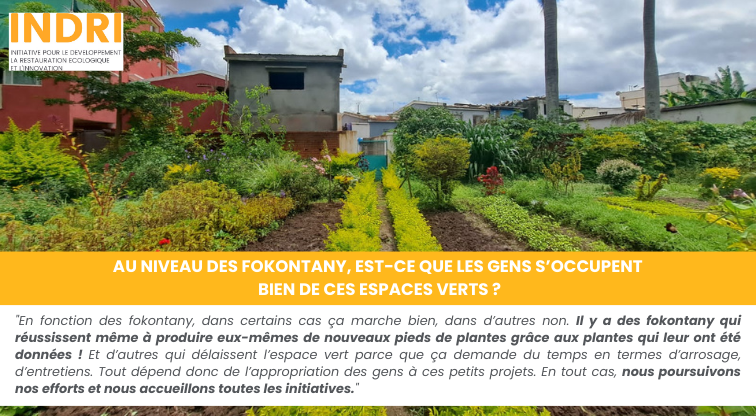
Currently, we observe that people are interested in green spaces, but not everyone has a green thumb, so we provide technical support to teach people how to take care of them. After that, it takes time and we really do awareness work. Depending on the fokontany, in some cases it works well, in others not. There are fokontany that even manage to produce new plant cuttings themselves from the plants given to them! And others that abandon the green space because it requires time for watering and maintenance. Everything therefore depends on people’s ownership of these small projects. But concretely, we continue our efforts and we are open to everyone, welcoming all initiatives.
What are the challenges and obstacles to overcome in creating green spaces in the city, such as the lack of available land or financial resources?
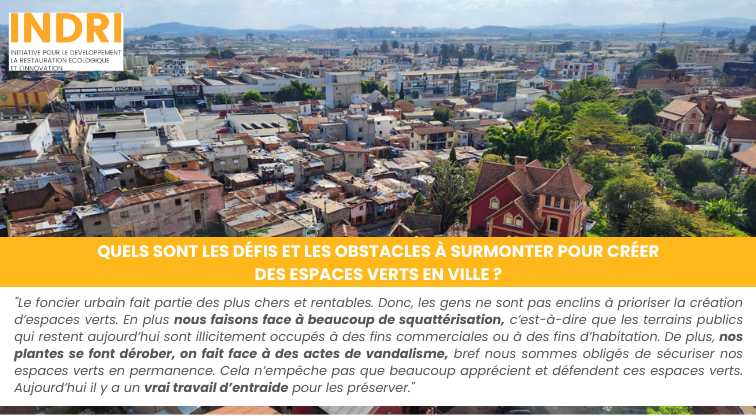
Indeed, urban land is among the most profitable, with very high monetary value. As a result, people are not inclined to prioritize the creation of green spaces. Furthermore, we face a great deal of squatting — i.e., the public lands that remain today are illegally occupied for commercial or residential purposes. It never happens that someone spontaneously chooses to plant a tree instead of a kiosk. Beyond that, the other difficulty remains security.
I talk a lot about ownership, because green spaces remain a common good, and this conception of the common good remains a major challenge in the city. Our plants are stolen, we face acts of vandalism — in short, we are forced to permanently secure our green spaces. But concretely, this does not prevent many people from appreciating and defending these green spaces, and today there is mutual support between residents and the municipality to ensure the sustainability of the investments made.
How can local authorities and citizens work together to create and maintain green spaces or farmland in the city?
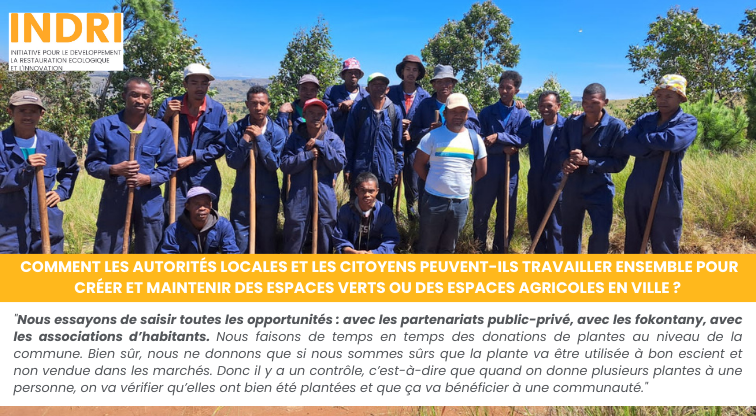
We try to seize all opportunities: with public-private partnerships, with fokontany, with residents’ associations… From time to time we make plant donations at the municipal level. At one point, we worked with the Embassy of Japan to give Japanese cherry tree saplings to applicants. We carry out small operations like this and we are really open to giving plants if there are interested people, depending on our production capacities.
Of course, we only give if we are sure the plant will be used wisely and not sold in markets. So there is a control system: when we give several plants to a person, we check that they have actually been planted and will benefit a community. We do not give plants for private gardens, because the priority is the well-being of all over individual interest.
Which reforestation approaches are most effective for restoring degraded areas in urban or peri-urban environments?
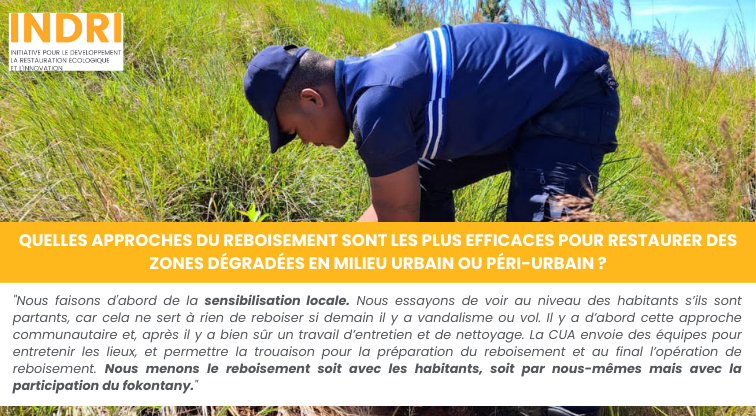
Urban reforestation requires, first of all, available land — which remains complicated. We work extensively on public rights-of-way, that is, around road corridors for example, or infrastructure belonging to the State or remnants of State land. In all cases, the operations carried out involve local awareness raising. We try to see whether residents are willing, because there is no point in reforesting if tomorrow there will be vandalism or theft.
There is first this community approach, and then of course there is maintenance and cleaning work. The CUA sends teams to maintain the sites and prepare digging for reforestation, and finally the reforestation operation itself. We carry out reforestation either with the residents, or by ourselves but with the participation of the fokontany. We don’t do much urban reforestation because we lack space.
What is important is that in urban planning we provide for the acquisition of sufficient land to allow reforestation in the city. So in the plans being prepared (the PADARM around the Iarivo ring road and the PRODUIR, in the first and fourth districts), areas to be reforested are planned.
How can urban or peri-urban green or agricultural spaces help mitigate the effects of climate change, especially flooding for Antananarivo?
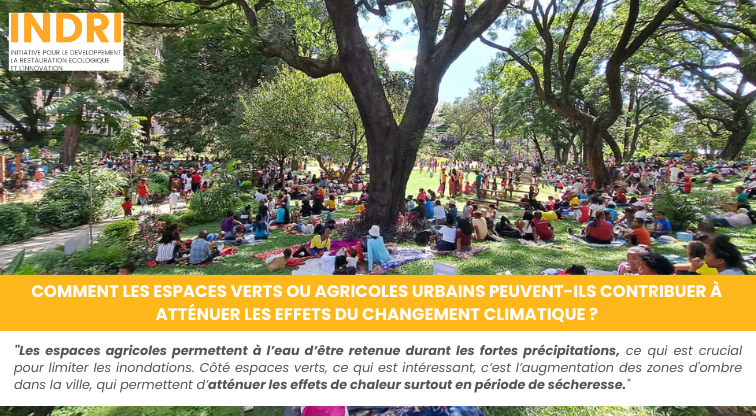
Agricultural spaces allow water to be retained during increased rainfall — they are natural retention basins. It is important to preserve them so that they continue to play this role in sanitation in the city of Antananarivo.
As for green spaces, what is interesting is the increase in shaded areas in the city, which help mitigate heat effects, especially during dry periods. Last year there was a severe drought in Tana, and we all know that climate change will accelerate. In this context, trees are very important to mitigate sharp temperature rises in urban environments, which are mainly made of bricks, concrete, glass, and so on. This allows us to live better and to have a better environment, oxygen, and slightly fresher and healthier air.
You are one of the co-founders of INDRI — could you tell us about what motivates you in INDRI’s approach in Madagascar?
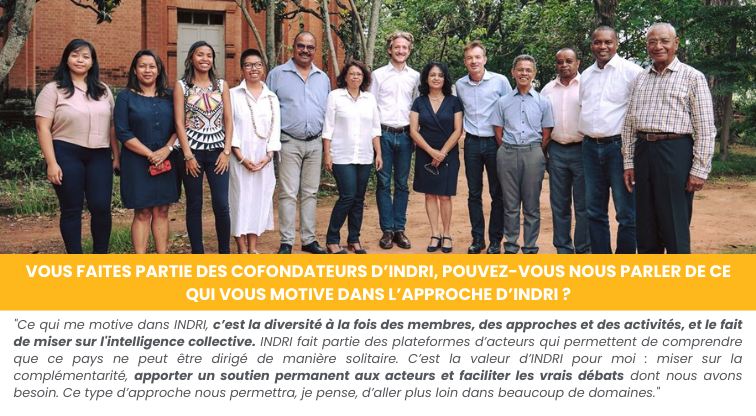
What motivates me at INDRI is the diversity of members, approaches and activities, and the focus on collective intelligence. INDRI is one of those stakeholder platforms that helps us understand that this country cannot be led in isolation. On the contrary, Madagascar needs well-led, courageous exchanges in order to define our identity and our path together. On every major challenge, the goal is to be able to collectively define strategies that are shared and owned by the various stakeholders.
It really is this participatory spirit, this permanent co-working that allows us all to grow. And that is where there is an exchange of knowledge, culture, and values that will enable the country and its inhabitants to rise above what we live today. That is INDRI’s value for me: investing in complementarity, providing permanent support to stakeholders, and facilitating the genuine debates we need. This kind of approach will, I believe, allow us to go further in every field.