

More than 100 stakeholders have together defined a charter of good reforestation practices to support the regreening of Madagascar. Let’s implement them together!
CLICK HERE TO DOWNLOAD THE FULL 10 PRINCIPLES DOCUMENT
A national emergency – The retreat of forests and the degradation of landscapes are alarming, with serious impacts (erosion, desertification, droughts, floods, etc.) further accentuated by climate change. The Red Island must once again become the Green Island: this conviction is shared by the authorities, civil society, businesses, technical and financial partners, and a large part of the population. More and more stakeholders are stepping up.
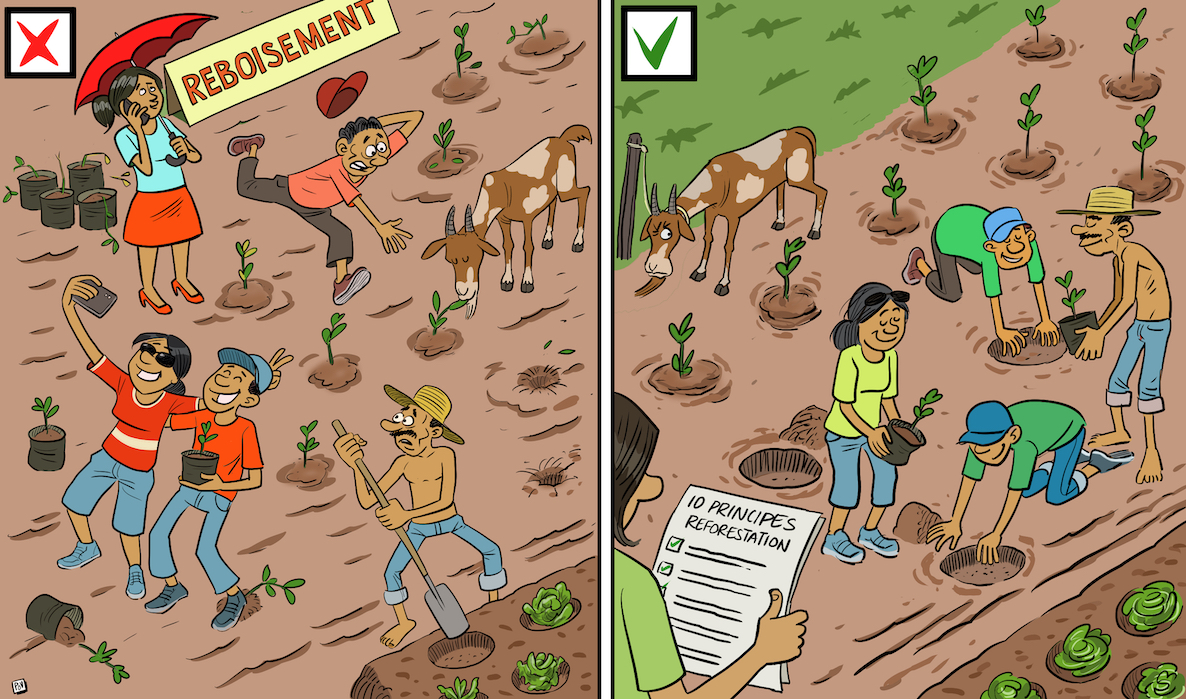
Difficulties to overcome – Unfortunately, many reforestation initiatives fail due to a lack of community involvement, suitable techniques, financing, planning, and monitoring. Reforestation is often disconnected from the realities of the surrounding landscape. Coordination and information sharing are insufficient — too many actors start from a blank page without taking into account available data and the experience of their elders.
A collective approach – Faced with these challenges, the members of the Alamino initiative have brought together in a single document all the key principles for a successful reforestation initiative. These principles pool the knowledge and experience of a wide diversity of stakeholders.
A practical and evolving guide – Each principle is broken down into key actions. This document is aimed at a wide audience, both expert and beginner. Some steps may seem obvious to specialists, but all of the points addressed are important. We ask project leaders to “check off” as many key actions as possible and to share their feedback with us to improve this document.
We call on all reforestation project leaders to commit to these 10 principles, which are essential for the successful regreening of our country.
1. COMMIT FOR THE LONG TERM
Reforestation is not just about planting! Preparation, maintenance, and monitoring are equally important. You must:
-
- Define the objectives: is it production reforestation (fuelwood, construction wood, fruit, etc.), protection (of soils, watersheds, water resources, coasts, etc.) and/or restoration and conservation of natural forests and biodiversity?
- Establish a site planning and maintenance plan (choice of species, soil preparation, planting method, layout and density of trees, watering, protection against illegal cutting, fire and livestock, creation and maintenance of firebreaks). Clearly identify the people involved at each step.
- Ensure the financial viability of the project, either through its economic profitability (production of fruit, non-timber products, fuelwood or timber with rotation), or through sustainable financing.
- Invest credibly by avoiding at all costs superficial reforestation projects done solely for communication purposes.
- Plan from the outset for sufficient resources for maintenance, monitoring and evaluation of the project, with indicators to evaluate plant survival rates over several years.
2. INTEGRATE REFORESTATION INTO THE LANDSCAPE
The forest is a major element of the landscape mosaic. Reforestation must be complementary to other surrounding activities so that the landscape meets ecological, economic and social needs. You must:
-
- Take landscape activities into account: agriculture, livestock, fishing, tourism, crafts, transport, energy production, etc.
- Contribute to maintaining or restoring the major ecosystem functions of the landscape: water resources, soil quality, biodiversity maintenance.
- Take into account the protection of existing forests and the possibilities for natural regeneration of the forest, or assisted natural regeneration.
- Promote the protection of animal species (lemurs, birds, etc.) that play important roles in seed dispersal and naturally contribute to forest and landscape restoration.
- Anticipate as much as possible the broader phenomena affecting the area: climate change, insecurity, migrations, major projects, etc.
3. TAKE LOCAL INTERESTS INTO ACCOUNT
Reforestation must identify and take into account local constraints, demands and needs. This step is crucial to involve and motivate communities and other stakeholders. You must:
-
- Consult the inhabitants of the territory from the diagnostic phase. What is their situation? What are their needs and expectations? They must be involved in defining the project and its objectives.
- Also consult other local actors: local authorities, NGOs, the private sector, civil society organizations, spiritual and traditional leaders.
- Ensure that reforestation reflects these consultations, meets identified needs (well-being, decent income, food security, water resources, etc.), and values local know-how.
- Ensure that the project’s benefits are distributed equitably among the inhabitants.
- Ensure that communities have a concrete interest in the reforestation, so that they can take ownership of it and care for it.
4. INVOLVE LOCAL POPULATIONS
Planning and implementation must closely involve communities, structures and local authorities, providing them with appropriate support. You must:
-
- Identify the local structures to involve, formal and informal, representative of the diversity of the inhabitants of the territory (youth, women, different ethnic groups, etc.).
- Raise awareness among mayors, fokontany presidents, community and spiritual leaders, youth and the general population about the issues of reforestation, for example through exchange visits.
- Involve these stakeholders in awareness-raising activities, in the management of nurseries (which should be located as close as possible to inhabitants and reforestation sites) and in the planning, management and monitoring of reforestation.
- Where possible, transfer resources (materials, plants, etc.) and responsibilities to the identified local structure(s). Provide them with the necessary support and ensure that this transfer is inclusive, equitable and validated by the fokonolona.
5. SECURE LAND TENURE AS BEST AS POSSIBLE
Reforestation projects must ensure that the population and local stakeholders are not deprived of the benefits of reforestation. There are several options on land tenure issues:
-
- Whenever possible, reforest on land that you own or whose tenure is clear, with a motivated owner.
- In all cases, verify who owns the land where the trees will be planted.
- If necessary, work with the authorities to regularize the land’s tenure status. If the project is intended for a community, help them obtain rights.
- If a land title is not possible, find solutions so that the community retains the benefits of the reforestation. This is referred to as “securing use rights”.
- Carefully assess feasibility before making promises to communities about granting land titles for reforested land, to avoid counterproductive discontent.
6. PROPERLY PLAN THE PLANTING
For success, reforest at the start of the rainy season. This requires good planning and adherence to it, with enough time for each step: choosing the site, preparing nurseries, dialoguing with local actors, planning human and logistical resources, etc.
-
- Define an optimal calendar, ensuring that young plants are in the ground by the start of the rainy season. Stick to this schedule for a successful planting!
- Determine the exact reforestation area. Find a location where soil and climate are suitable, ideally close to a water source for nursery and plantation watering. Record the geographical coordinates of the land to facilitate monitoring.
- Obtain or produce quality seeds or plants. Make sure of the seeds’ origin, follow germination protocols, sort plants in the nursery beforehand, and carefully transport plants to the reforestation site to avoid damaging or drying them out.
- Plan for sufficient material and human resources (transport for participants, drinking water, snacks, tools, watering cans, bins, etc.).
- Plant quality plant material: ensure the origin of seeds, sort plants in the nursery beforehand, and carefully transport plants to the reforestation site to avoid damaging them.
- Plan for the recovery of all waste including plastic bags used for young plants, or use biodegradable or reusable material.
7. CHOOSE THE RIGHT TREES
The choice of trees is a crucial step. It is about both optimizing plant survival chances and meeting the reforestation project’s objectives: support for communities, restoration of ecosystems and biodiversity, climate resilience, etc. You must:
-
- Take into account the objectives of the initiative and the needs expressed by local communities (such as: cash trees, fruit trees, fuelwood, fast-growing trees).
- Choose trees adapted to the climate and soil of the planting area. Note: eucalyptus consume a lot of water, and pines and acacias are invasive and must not be planted near protected areas.
- As far as possible, plant native trees, i.e. originating from Madagascar. This point is essential for restoring natural ecosystems and promoting biodiversity.
- Anticipate the likely effects of climate change, for example by choosing species resilient to rising temperatures and aridity.
- In areas exposed to erosion (watersheds, lavaka, mobile sand dunes), include trees or plants (vetiver, bamboo, etc.) able to fix and restore soils.
8. PROPERLY TRAIN PARTICIPANTS
It is crucial to mobilize the right technical skills and to properly train all the people involved. You must:
-
- For project design, call on competent people to design a reforestation that meets the needs of the site, climate and local context.
- Train all reforestation project actors, including local communities.
- If necessary, train local trainers, who will share information with each individual.
- Include in the training not only planting techniques, but also maintenance and monitoring. Raise awareness about the importance of trees and forests.
- Use suitable training materials, in particular visual materials in case of illiteracy.
9. COORDINATE WITH OTHER ACTORS
Reforestation actors (authorities, civil society, NGOs, private sector, technical and financial partners, etc.) must coordinate their actions, share good practices and contribute to resolving obstacles at local and national levels. You must:
-
- Collaborate with local authorities (communes, fokontany, customary authorities) to define the project and follow up (for example to ensure that reforestation sites are protected from fire).
- Inform the Regional Directorate of Environment and Sustainable Development (DREDD) about planned reforestation actions, in order to allow coherent monitoring at country level.
- Exchange with relevant stakeholders in the region, to share solutions and enrich the project.
- Take part in local or national consultations on regreening, such as the Alamino initiative, which is open to all.
10. USE AND SHARE INFORMATION
Reforestation actors must avoid starting from a blank page. On the contrary, the experience accumulated in the past must be valued and existing guides and documents used. Each project must also share its own information. You must:
-
- Take into account previous and ongoing projects and initiatives in the intervention area, analyze their successes and failures, and capitalize on the lessons of these experiences.
- Obtain the main guides and documents prepared by public authorities and other reforestation stakeholders.
- Provide feedback to the authors of these guides from the field, allowing the available documents to be improved. For example, do not hesitate to send comments to INDRI on the 10 principles (alamino@indri.solutions).
- Share your own information to help other actors. Publish the data you have (lessons learned, practical information, advice, etc.).